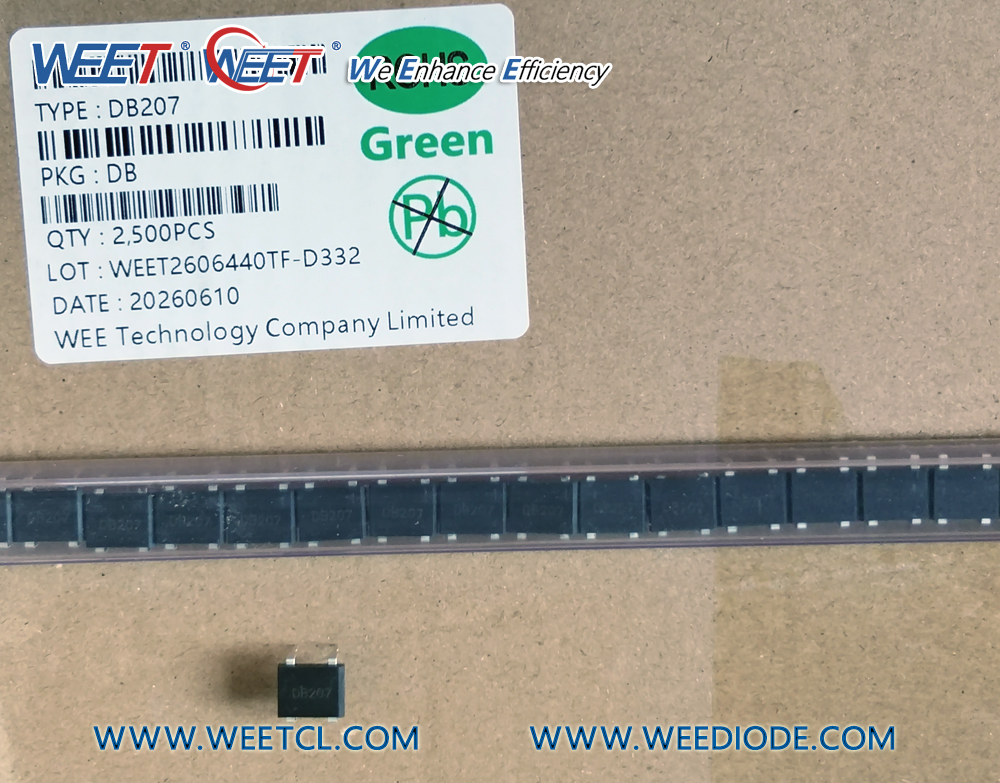
After full wave rectification, the 50Hz AC voltage is converted into a pulsating DC voltage u1, and then the DC high voltage U1 is obtained through the input filtering capacitor. Ideally, the conduction angle of the rectifier bridge DB207 should be 180 ° (with a conduction range of 0 ° to 180 °), but due to the effect of the filtering capacitor C, it can only approach the AC peak voltage for a short period of time before the input current flows through the rectifier bridge to charge C. The half cycle of 50Hz AC power is 10ms, the conduction time of the rectifier bridge is iC ≈ 3ms, and its conduction angle is only 54 ° (conduction range is 36 °~90%). Therefore, the rectifier bridge DB207 actually passes narrow pulse current.
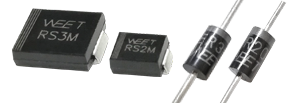
The primary conduction process of a rectifier diode can be regarded as a "gate pulse", with a pulse repetition frequency equal to the frequency of the AC power grid (50Hz)In order to reduce the conduction noise below 500kHz in switching power supplies, sometimes two ordinary silicon rectifiers and two fast recovery diodes are used to form a rectifier bridge.
Parameter selection of rectifier bridge DB207The isolated switch mode power supply uses a rectifier bridge composed of rectifier tubes, or can directly use a finished rectifier bridge to complete bridge rectification. The full wave bridge rectifier DB207 is called a silicon rectifier bridge, which is a semiconductor device made by connecting four silicon rectifier tubes into a bridge circuit and then encapsulating it with plastic. DB207 has the advantages of small size, easy use, and good consistency of various rectifier parameters, and can be widely used in the rectifier circuit of switching power supplies. The silicon rectifier bridge DB207 has four terminals, including two AC input terminals and two DC output terminals.
The average maximum rectified current of silicon rectifier bridge is divided into various specifications such as 0.5~40A, and the maximum reverse operating voltage is divided into various specifications such as 50~1000V. The low-power silicon rectifier bridge DB207 can be directly soldered.
Connected to the printed circuit board, large and medium power silicon rectifier bridges need to be fixed with screws and installed with suitable heat sinks.